
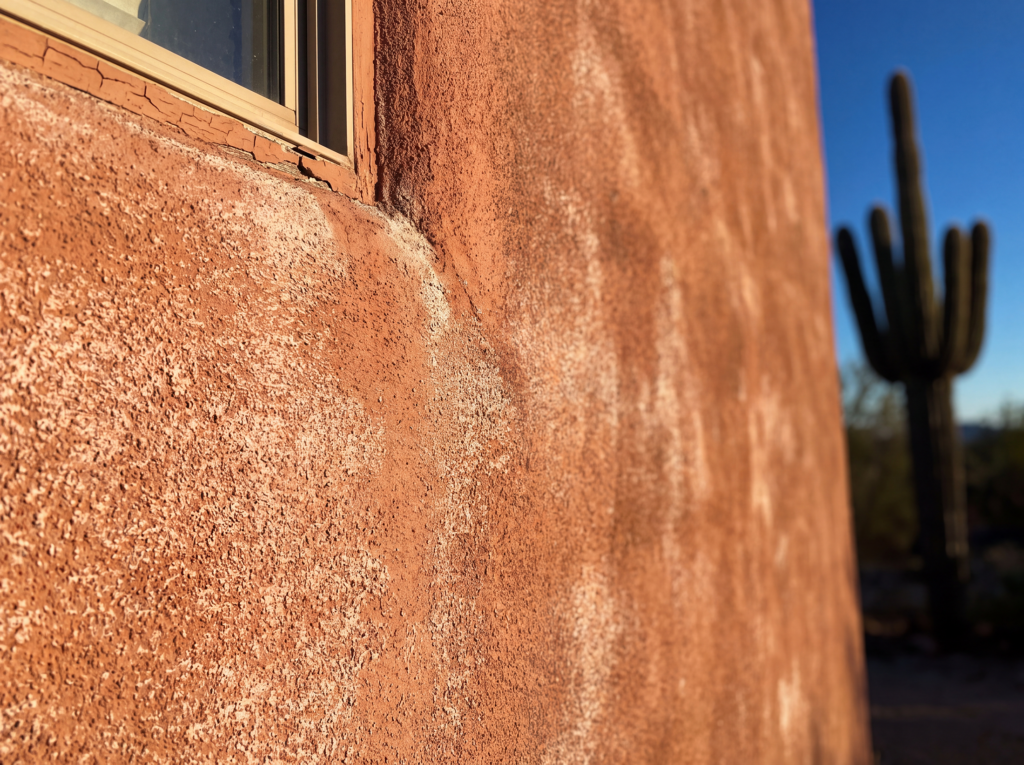
If your home’s paint job looks tired after just a few years, you’re not imagining it — and it’s probably not a sign of poor workmanship. Arizona’s sun is doing exactly what desert sun does: breaking your paint down from the inside out.
The Sun Is a Chemical Problem, Not Just a Cosmetic One
It’s tempting to think of sun-faded paint as a simple cosmetic issue — a little duller, a little less vibrant. In reality, ultraviolet radiation attacks paint at the molecular level. UV rays penetrate the paint film and gradually break the chemical bonds in the resin binder — the component that holds pigment particles to your walls and to each other.
Sherwin-Williams’ own technical guidance on exterior finishes puts weathering protection at the center of what paint is supposed to do in the first place: a quality painted surface is meant to block harmful UV rays while sealing the substrate underneath. When that protective layer starts to break down, everything it was protecting — your stucco, wood trim, or siding — is exposed to the elements underneath a failing coating.
What UV Breakdown Actually Looks Like
Paint degradation from sun exposure generally shows up in a predictable sequence:
- Fading first. Pigments lose vibrancy as UV energy breaks down the color molecules. Darker and more saturated colors typically fade faster, since they absorb more UV energy than lighter shades reflect.
- Chalking next. As the binder deteriorates further, it leaves behind a fine powdery residue on the surface — a telltale sign you can check yourself by running a hand across the wall. Painting industry resources consistently identify chalking as the most visible, most reliable early warning sign of UV-driven binder breakdown, and it means the paint film has already lost real protective value, not just curb appeal.
- Cracking and peeling last. Once the binder is compromised, the paint film becomes brittle and loses adhesion, opening the door for moisture intrusion — a serious concern heading into monsoon season.
Why Arizona Accelerates the Timeline
Every climate exposes paint to some UV stress, but the Phoenix Valley compounds the problem in a few specific ways:
UV intensity. Arizona’s sun exposure sits at a lower latitude and higher elevation than most of the country, with far fewer cloudy days to interrupt exposure — meaning painted surfaces here absorb a significantly higher cumulative UV dose over a given year than the same paint would in a milder climate.
Thermal cycling. Desert homes swing through extreme daily temperature ranges — scorching afternoons followed by much cooler nights. That expansion and contraction stresses the paint film independently of UV damage, and the two effects compound each other: UV embrittles the film, then thermal movement cracks the film that’s already lost its flexibility.
Sun exposure by elevation. South- and west-facing walls take the most direct, sustained exposure through the hottest part of the day and typically show fading, chalking, and cracking well before north-facing walls on the same house.
The practical result is that exterior paint in the Phoenix Valley simply doesn’t get the lifespan homeowners expect from national paint-can labels or from experience in other states. A repaint cycle that might stretch past a decade in a temperate, cloudier region is often considerably shorter here — sometimes under half that, depending on color, orientation, and paint quality.
What Actually Helps
The good news: none of this means your home is destined to look faded and chalky between paint jobs. A few factors make a measurable difference:
- Paint quality and formulation. Premium acrylic exterior paints use more resin and better UV-stabilizing pigments than economy lines, and it shows in how long the color and film integrity actually hold up under sun stress.
- Color selection. Lighter colors reflect more UV energy than they absorb, which slows fading and reduces the thermal cycling stress on the paint film — worth factoring in during color selection, especially for south- and west-facing elevations.
- Proper surface prep. UV damage often reveals underlying prep issues — paint applied over a chalky or contaminated surface fails faster regardless of how good the product is.
- Timing your repaint before failure, not after. Catching chalking early, before it progresses to cracking and moisture intrusion, protects the substrate underneath and keeps repair costs from escalating.
The Bottom Line
Fading paint in Arizona isn’t a flaw in your home or a sign your last paint job was subpar — it’s physics. Understanding how UV radiation actually degrades a paint film helps homeowners plan realistic maintenance timelines instead of being surprised by it, and it’s exactly why paint selection and prep matter more here than almost anywhere else in the country.